Showing posts with label grade 1. Show all posts

Friday, October 27, 2023

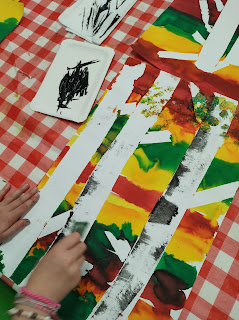
Autumn birches


You need: 

  1. drawing sheets A3 size
  2. painters tape in several widths
  3. liquid watercolor paint in red, green and yellow in rood, geel en groen
  4. brushes
  5. tempera paint  
  6. stipple brush
  7. old shopping card/customer card
  8. saucers
  9. jars
Choose thick drawing paper,  to avoid ripping when you remove the tape . 

Look at birch trees. What do you see?   
 

  • straight trunks
  • trunks are white
  • horizontal peeling bark banden
  • autumn color leaves: orange, yellow, brown, red
What to do?

Step 1
Palce the sheet on the table with the narrow site down.  Stick strips of tape from top to bottom. Wide for the trunks, narrower for the branches. Note: branches grow up and not down. 


Step 2
Paint the background in strips with diluted liquid watercolor. Let dry. Peel off the tape carefully. 

Step 3
Put some black tempera paint on a saucer. Dip your customer card in the paint. Pull this in several places from left to right (or right to left!) to halfway up the trunk to make the black streaks.

  
Step 4
Spray som warm colors tempera + green on a saucer.  Stipple leaves at the top of the trees using the stipple brush. Do not mix the colors, but use several colors at the brush at the same time.  


Step 5
Hang up! 


Artworks are made by students of grade 1. 

Saturday, July 8, 2023

Fun flowers


You need:
  1. white or colored drawing sheet
  2. scraps of colored paper 
  3. scissors
  4. glue
  5. black markers

Cut several circles from scraps of colored paper and paste them om the drawing sheet. Paste smaller circles on the bigger ones. Draw petals using several black markers in several thicknesses.   

Source: Krokotak.com

Monday, April 3, 2023

Water lilies on a plate


By a student of grade 1

Claude Monet (1840-1926) is considered one of the most important painters of Impressionism. 

 Typical for Impressionists:

  • they choose subjects from ordinary life 
  • special attention for light and color
  • work in the open air
  • smooth brushstrokes
  • dashes resemble a sketch
  • it's about the impression!

Monet had a large garden with a pond and a Japanese bridge in Giverny France. He liked to paint in that garden. His works of water lilies are therefore famous.

Discuss the term impressionism. Show some paintings by Monet and zoom in on a work with water lilies in Arts & Culture. Do students see the characteristics of impressionism in this artwork?

You need:
  1. paper plates
  2. tempera paint in blue and white 
  3. stencil brush
  4. white drawing sheet 
  5. tissue paper in green an light green 
  6. water and sponge
  7. tissue paper in pink and yellow
  8. mold of a water lily leaf
  9. glue
  10. scissors
Step 1:
Dab the plate with blue and white.  


Step 2:
Wet the white paper with a sponge. Cut squares from the green tissue paper. Place them on the wet paper and let the bleed. Let dry.


Step 3
Remove the tissue paper. Trace the mold of the lilyflower leaf and cut it out.  


Step 4
Fold the tissuepaper for the lily twice diagonally. Cut a flower shape. 


Step 5
Grab the flower shapes in the middle. Crumple them into a flower. Put a drop of glue on the lily leaf and stick the center of the lily on top. Roll a wad of leftover tissue paper and stick it in the center of the flower.

Elements of art: texture, color, space. 

Wednesday, March 15, 2023

Snowdrops

 You need:

  1. white construction paper 10 by 10 cm and 15 by 15 cm
  2. oilpastel
  3. soft crayons
  4. white drawing sheet
Draw a frame around the drawing sheet at 1 cm from the edge. Color the background with oil pastel, pastels or a combination of these. Only use the colors yellow, green and blue.
Draw two flower stems with green oil pastel. 
Fold two snowdrops from the white sheets. Stick them on the work. 


Elements of art: color, nuance. 

Saturday, January 21, 2023

Collage in one color

 You need:

  1. several things in one color 
  2. camera


This is a homeschooling assignment. 
1. Collect small items of the same color in your house. The more, the better!
2. Place them on a white surface. 
3. Your items may touch each other, but don't have to. 
4. Make sure the edges are straight.
5. Take a picture of your collage.
6. Send the photo to your teacher. 
 
Elements of art: space, color. 

The photo's and collages are made by students of grade 2.


Sunday, November 27, 2022

Scratch a Christmas ball

You need:
  1. drawing sheet
  2. oli pastels or crayons
  3. black tempera paint 
  4. brush
  5. alufoil 
  6. ribbon
  7. toothpick or skewer
Color the sheet with crayons. Paint it over with black tempera paint and let dry. Scratch with a toothpick or skewer a Christmas ball and fill it with patterns. 
Cut a small piece of aluminumfoil and paste it on the ball with a folded ribbon under it. 

made by students of grade 6

Elements of art: line (pattern)


Tuesday, November 8, 2022

Same insect - different colors


made by student of grade 1

You need:
  1. drawing sheets A5 size
  2. crayons
  3. liquid watercolor paint 
  4. brush
Draw two the same insects and color them with crayons: one with cool colors, the other with warm colors. 
Paint the background with dilluted watercolor paint: warm colors for the 'warm' insect, cool colors for the 'cool' insect. 


Element of art: color.

Monday, November 7, 2022

Transport in the style of Hundertwasser


Friedensreich Hundertwasser (1928-2000) was an Austrian artist and architect who is best known for the colorful buildings he designed, built with attention to the environment and nature. The buildings of Hundertwasser are very recognizable: straight lines are missing, there is use of bright colors and many of his buildings have typical turrets. The influence of architect Gaudi is obvious.


The paintings of Hundertwasser have exuberant colours too and mainly undulating lines.


Show buildings of Hundertwasser on the digital board. Discuss the salient  features: bright colours, undulating lines. Then show some paintings and discuss the things that stand out:


• the use of small areas outlined with black

• no straight lines, usually parallel lines

• recurring spiral shapes

• bright colours


Tell students they are going to draw means of transport in the style of Hundertwasser. 


You need:


  1. drawing sheet

  2. pencil

  3. markers


Draw a car, plane, boat or something you think is a mean of transport. Fill it with lines and patterns like Hundertwasser did. Cut your drawing and paste all means of transport on a great colored sheet. 

Saturday, October 22, 2022

Keith Haring figures on tissue paper

made by students of grade 3

You need:
  1. colored tissuepaper
  2. white drawing sheet
  3. jar with water
  4. brush
  5. scissors
  6. templates of Haring figures
  7. pencil
  8. black marker

Choose 2 or more colors of tissuepaper. Fold them in 16 squares. Cut out. 
Take a sheet of drawing paper, make it wet with a brush and water. Lay the pieces of tissue paper on this wet sheet and see how they bleed. Fill the whole sheet and be sure to use enough water. 
Let dry and remove the tissue papers. 
Cut two or more Haring templates and outline them with a pencil. Trace those lines with black marker and trace them again to make nice bold lines. 

Tuesday, October 18, 2022

In 'The Factory' of Andy Warhol

made by students of grade 1

You need: 

  1. colored paper 12 by 12 cm
  2. black construction paper 50 cm by 15 cm 
  3. tempera paint
  4. brushes
  5. apples
  6. glue
  7. black marker 

Tell about Andy Warhol's Factory. 

First lesson: "We are going to work today in the factory of Andy Warhol. Choose four colored sheets. Make apple prints in complementary colors: on a blue sheet you print an orange apple, on a red sheet you print a green apple etc."

Let dry and paste the colored sheets on black construction paper.

Second lesson: make a second print in a complementary color: on the orange apple you print a blue one etc. Let dry. Outline the apples with a black marker and add seeds and stem. 


Wednesday, August 10, 2022

Zebra


You need:


  1. drawing sheet A3 size 

  2. drawing sheet A3 size

  3. tea

  4. glue

  5. sand

  6. brush

  7. charcoal

  8. wool in black and white

  9. scissors


After reading The zebra who ran too fast fro Jenni Desmond we did this lesson. 


Dillute glue with a cup of strong tea and add some sand. Paint the large sheet with this. Color and texture will emphasize the natural habitat of the zebra. 


Fold the other two sheets in half and cut a neck and head (oval). 


Use charcoal to draw vertical lines on the head and horizontal lines on the body. Cut ears and draw lines on them. Cut pieces of white and black wire and paste them. 


Elements of ard: line, shape and texture.
Techniques: cut and glue, draw with charcoal

Monday, January 31, 2022

Son of Man - Like Magritte


You need:


  1. white drawings sheets A3 size

  2. white and blue tempera paint 

  3. paper with stone print

  4. white round paper

  5. camera

  6. bowler hat and black coat 

  7. brushes

  8. small dishes

  9. sponges


René Magritte

Rene Magritte is born in 1898 in Belgium. When Magritte is 13 years old, his mother commits suicide. She jumps in the river Samber and is found with her dress covering her face. This image has been suggested as the source of several paintings from Magritte: people hiding their faces with several objects.

In 1924 Magritte became friends with members of a surrealism group in Brussels: André Breton, Joan Miró and Salvador Dalí. These artists influence Magritte's work. In the end Magritte became famous with surrealistic paintings.

Magritte gave his paintings a realistic effect of surrealism. He painted simple objects, like a shoe, an apple, a pipe or a tree. Magritte took these things out of their ordinary environment and placed them in a special surrounding.

One of Magritte's most famous works is "La Trahison des Images" (The Treachery of Images). This is a very realistic painting from a pipe, with the text: Ceci n'est pas une pipe (This is not a pipe). The painting is not a pipe, but rather an image of a pipe. As Magritte himself commented: "The famous pipe. How people reproached me for it! And yet, could you stuff my pipe? No, it's just a representation, is it not? So if I had written on my picture 'This is a pipe,' I'd have been lying!"

By putting us constantly on the wrong track, Magritte forces us to think about art. Magritte thought it the task of an artist to place reality in a different context.


Look at the artwork

Discuss the painting The son of man. What do you see? What does the man wear? What's on his head? Why can he see little? Can he see nothing of can he peek at the edge of the apple? What's wrong with his left arm? (his arm appears to bend backwards at the elbow). What do you see at the background? What does the sky look like?


How do you make this artwork?

Take photographs of the students wearing a bowler hat and a dark coat; arms hanging beside the body. Students paint their sheet blue and let it dry. Cut a wall out of stoneprint paper and stick it on the blue sky. Stamp white spots on the artwork using a sponge. Let dry againg. Cut the photo neatly along the edges and paste it on the blue sheet in front of the stoneprint paper. Draw a piece of fruit on the circle sheet and show color transitions, just like real fruit. Paste it on the face.


Both artworks are made by students of grade 1


Tuesday, January 11, 2022

Corneille China


Made by a student of grade 1

You need:


  1. paper plates)

  2. black markers

  3. acrylic paint

  4. small brushes 

  5. jars with water and paper towels


Show some pictures of animals in Corneille's artwork. What do you see? What can you say about the colors? Do you like it? Why or why not? What animals do you see on the china?


Choose an animal. Use a black marker to draw it on your plate. You can also decide to draw just the head of the animal. Your drawing has to be large, it has to fill almost the entire plate. Can you think of anything else? Does the moon shine? Is your animal with others? Or is it in the grass? You can make it!


Color your drawing with acrylic paint and a brush. Choose bright colors and make sure it's opaque. Rinse your brush with each new color and dry it well in a paper towel; the acrylic paint shound not get wet.


Trace the marker lines again if necessary but only if the paint is really dry.


More information about Corneilla and the Cobra group on this blog:  Lesson 1 en lesson 2.

Thursday, December 16, 2021

Dancing Christmas trees


Made by a student of grade 1

You need:


  1. white drawing sheet

  2. pencil

  3. markers

  4. chalk pastels


Dancing Christmas trees are Christmas trees who look like them only because of the shape (rectangular) and decorations (balls, garlands and stars)! The trunks are much longer than the  the ordinary trees and because of the curves in them it looks they are dancing.  

Draw with pencil, colour with markers, outline with black marker and colour the background with chalk pastels.


Friday, November 5, 2021

Weaving like Mondriaan


Made by a student of grade 2


You need:


  1. white sheet A4 size

  2. colored paper strips in primary colours

  3. scissors

  4. glue

  5. black fineliner 


Fold the white sheet in half.

Cut evenly-spaced slits starting from the folded edge and continuing up to about a half inch from the opposite. Open up the paper.

Take one paper strip and weave it across the slits, going over and under them. Push the strip to the top and start with another one. The second strip should be woven in an opposite pattern as the first one. If the first strip goes over and under across the slits, the second one should go under and over the slits.

Continue weaving until the white sheet is full. Paste the ends of the strips on the white sheet.

Create a frame by pasting the artwork on black construction paper. Draw small patters on the white strips using a fine black marker. 

Thursday, October 14, 2021

Happy monsters

You need:


  1. drawing sheets A3 size

  2. markers

  3. tempera paint


Draw happy monsters! Not the scary types, but the nice ones with big eyes. Color with markers, background with tempera. Outline with black marker.


Made by students of grade 6


Monday, August 23, 2021

The very lonely firefly


You need:


  1. black construction paper

  2. tempera paint

  3. brushes

  4. gold and silver markers

  5. pencils


Book: The very lonely firefly from Eric Carle (also to be found on YouTube)


Students use white tempera to paint two or more jars at the bottom of the black sheet. They mix yellow and blue to paint grass in different shades of green over the jars. Draw fire flies with gold and silver markers and color them with pencils. 


Thursday, April 29, 2021

Birdies on a branch


Made by a student of grade 1


You need:


  1. liquid water color paint

  2. brushes

  3. crayons

  4. white sheet

  5. feathers

  6. glue


Draw a branch with some birdies on it. Their eyes should be big and white! Color the birds with crayons using bright colors. Paint the branch and background with water color paint. Let dry. Draw feet and paste feathers. 

Thursday, March 11, 2021

Printing African animals


You need:


  1. styrofoam


  2. pencil


  3. block printing ink


  4. paint roller


  5. flat piece of plexiglass


  6. coloured paper


Explain the principle of printing. Why is it that people started to print texts and pictures?


Draw an African animal with a pencil on the styrofoam. Press to get a print in the foam. Squeeze out “toothpaste” amount of ink on plexiglass. Roll ink out. The ink is ready when lines appear. Ink should look wet.

Put the styrofoam on a newspaper. Roll one colour ink onto the foam, working quickly to cover all areas. Lay a sheet on top of foam and press with a flat hand. Take away the sheet and your print is ready. Let dry and cut it with about 1 cm around. Paste one or more prints on a white sheet. 


All artworks made by students of grade 6

Sunday, December 13, 2020

Christmas trees in the snow


By students of grade 2


You need:


  1. large drawing sheets 

  2. liquid watercolour green and red 

  3. oilpastel crayons 

  4. brushes


Draw a wavy line, the ground. Draw several christmas trees. Simple triangles are okay, this lesson is about overlap - not all the trees next to each other. Decorate the trees with balls and garlands and draw presents under the trees. Colour with oil pastels. Use white oilpastel for snowflakes.

Paint with liquid watercolor, the ground has to stay white.